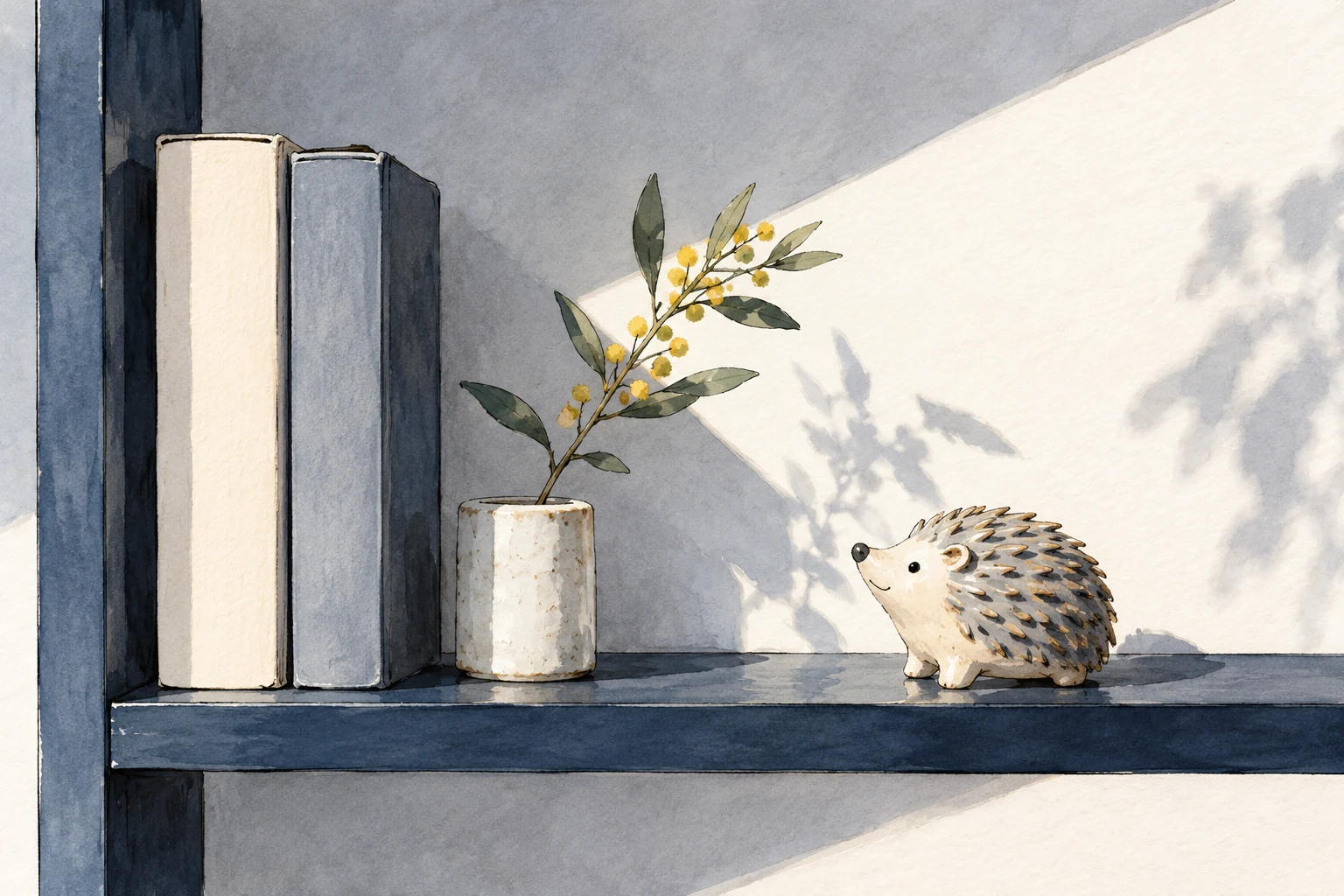
Editorial illustration of a small ceramic hedgehog with room to shine on a bookshelf.
A handmade hedgehog can disappear among a dozen ornaments or become the thing everyone notices. Usually, the difference is placement. Give that little face a clear background, some room around it, and a place in your normal line of sight.
Before rearranging the house, carry the hedgehog from room to room. Set it down, step back, and look again from the doorway. A spot that seems perfect close up can swallow a small object at a distance. These five starting points each offer a different sort of pleasure.
THE DESK THAT NEEDS A LESS SERIOUS COLLEAGUE
A desk is a good home for a hedgehog with a faintly officious expression. Position it just beyond the keyboard, somewhere you can see it while thinking, without sacrificing the space your hands need. A tiny creature apparently supervising a spreadsheet has considerable comic value.
Keep the immediate surroundings simple. A pencil cup, a lamp, and one small figure already make a scene. Add a phone stand, three cables, a stack of receipts, and an enormous water bottle, and the hedgehog starts looking like it needs rescuing.
Try turning it slightly toward your chair rather than squarely toward the room. That small adjustment makes the arrangement feel personal. If the desk gets crowded, use a stable shelf above it. Avoid balancing the figure on a monitor, where a nudge or a moving cable could send it flying.
THE BOOKSHELF WITH BREATHING ROOM
Books supply scale, color, and ready-made company for a handmade object. A pale felt hedgehog shows up well against darker bindings; a darker wooden one may look lovely in front of a light wall. The contrast matters more than matching every color.
Pull two or three books slightly forward, then place the hedgehog beside them. Leave a visible patch of empty shelf around its face. There is no need to buy a special stand or build a miniature forest. A little space lets the workmanship do the talking.
Resist using a delicate figure as a bookend unless it was actually designed for the job. Heavy books have poor manners. For ideas about looking closely at shapes and materials, the V&A’s collection-browsing guide is a pleasant starting point. You can search by material and notice which combinations appeal to you.
THE ENTRYWAY THAT GREETS YOU
The entryway offers a different reward: a familiar face at the point where you come home. A little hedgehog beside the key bowl can make an otherwise practical ledge feel welcoming. Choose the protected end of the surface, away from bags being dropped and sleeves sweeping past.
Think about the view with the front door open. Does the figure show up, or is it hidden behind the post? Sometimes moving a bowl a few inches is enough. A shallow tray can give a small arrangement a clear boundary, provided everything sits securely.
Keep one generous landing space completely clear. The arrangement needs to survive an ordinary Tuesday, when you have shopping in one hand and wet mail in the other. If you have to rearrange it every time you arrive, try a less busy spot.
THE BEDROOM’S QUIET CORNER
On a bedroom shelf, a handmade hedgehog can be quieter company. The softer textures of felt or stitched fabric sit comfortably near books and woven materials. A smooth ceramic figure offers a different pleasure: the way its outline catches the light.
Try placing it where you see it while drawing the curtains or putting a book away. A familiar daily movement gives you a reason to notice it. The bedside table works only if there is still enough space for the lamp, water, and whatever else belongs there.
Keep delicate pieces out of strong direct sunlight, especially dyed textiles. If you are uncertain about the material or finish, ask the maker about display conditions. You can find more general background in the Canadian Conservation Institute’s textile-care resources. A decorative figure should also stay beyond the reach of anyone likely to mistake it for a toy.
THE KITCHEN, AT A SAFE DISTANCE
The kitchen is where a lot of life happens, which makes it tempting hedgehog territory. A dry shelf near the breakfast things lets a small figure join the morning routine. A ceramic face peeping past a plain mug can be enough to make the corner feel finished.
Choose distance from the stove, sink, kettle steam, and food preparation. Felt absorbs kitchen grime rather enthusiastically, and decorative finishes may have cleaning limits. A sheltered shelf across the room is often a better choice than the counter itself.
Look at the arrangement in the evening as well as in daylight. Does a cupboard shadow hide the face? Is the spot still useful when you are cooking? The best placement feels easy to live with. For a gentler take on that everyday companionship, read THE HEDGEHOG BY THE KETTLE. Then give your own small resident a trial address. You will soon know if it belongs.