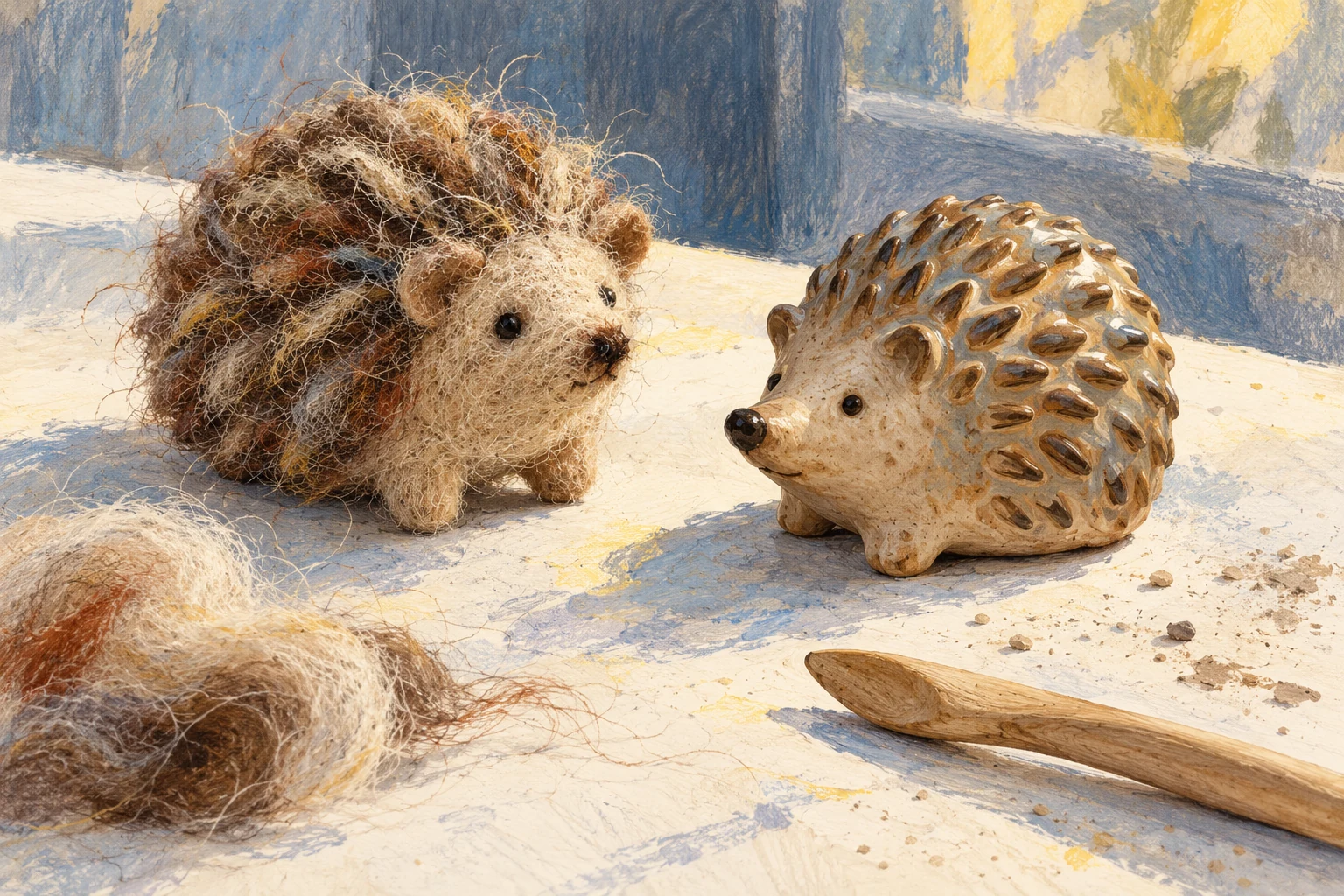
Editorial illustration celebrating the textures and individual faces of handmade hedgehogs.
Take two handmade hedgehogs made to the same design and put them side by side. At first they may seem like twins. Look a little longer. One has a more pointed face. One appears to be considering a difficult question. The other looks as though it has already eaten the evidence.
The difference might be almost nothing: an eye set slightly higher, a shorter snout, a small change in the curve of the back. Yet you will probably prefer one. You may find yourself unable to explain why.
That is a large part of the beauty of handmade novelty hedgehogs. The maker works at a scale where tiny decisions have outsize consequences. Move a nose a fraction and the whole expression changes. Add a little more fullness beneath the chin and a solemn creature becomes a contented one.
Materials join in. Wool has loose fibers that soften the outline. A stitched seam makes a small, readable path across fabric. Clay takes impressions from tools and fingers, then meets the complications of its finish. Wood offers grain that will not politely repeat itself from one piece to the next.
None of this requires a grand story about the maker. You can enjoy the evidence in front of you. Turn the figure gently, if its construction allows. Notice where the shape changes, how the underside is finished, and which details have been simplified. A convincing little hedgehog often relies on surprisingly few features.
If that looking makes you curious about other kinds of handwork, the V&A’s history of needlework samplers is an absorbing detour. It is a useful reminder that small stitches can carry practice, skill, and individual choices worth examining closely.
There is a limit to the romance of irregularity, of course. Handmade work deserves the same attention to sound construction as anything else. A wobbling base, a loose eye, or a crack is a practical issue. Calling every fault “character” does the maker and the buyer a disservice.
The interesting distinction is between a sound object with an individual expression and an object that needs fixing. The former can make you smile every time you pass it. The latter deserves an honest conversation with whoever made or sold it.
A crooked stitched nose on a well-made face may be exactly right. It gives your eye somewhere to return. You recognize that specific hedgehog among others. Eventually, it stops being “the ornament” and becomes the little creature beside the books.
That familiarity is earned through looking. The object does not have to be rare or technically dazzling. Sometimes a maker has simply found the right combination of round body, dark eyes, and absurdly earnest face.
For ways to give those details room to show, try our guide to displaying a hedgehog around the home. A little space and an uncluttered background are often enough.